
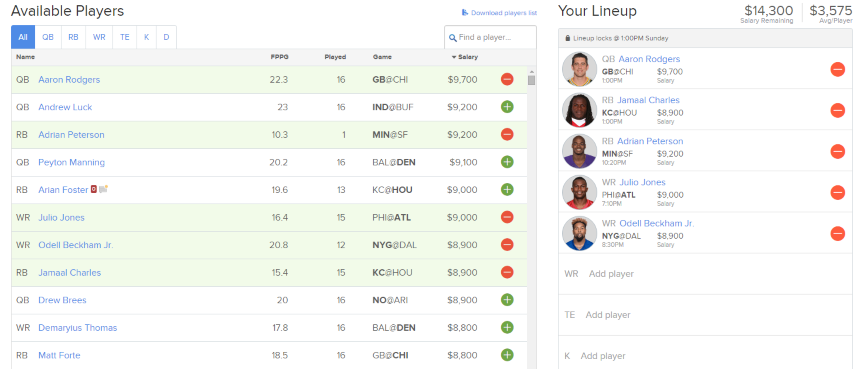
Predicting anything for the first week of NFL action is difficult. We don’t really have much to go on other than what players did last year, and what they’ve done so far in preseason. These things are both notoriously bad at predicting what will happen in Week #1. So, how should you proceed when it comes to putting together your daily fantasy football team?
The first step is to see what coaches are thinking as far as player placement goes. Through news reports, press conferences, and other NFL releases, we can see who is most likely to be a starter, and who will be playing a more supplementary role on their team. These things often take the average fan by surprise–such as Matt Cassel getting cut by the Bills–but they happen for a reason. Coaches are in their position for a reason; they know what they are doing. The decision to play one player over another, then, is an educated one and we can use it to fuel how we begin. If a top receiver on a team is reported to be having preseason difficulty and will be used less frequently at the start of the season, we should rely more heavily on the above average running back on that team as we form our roster. The RB in question will likely be underpriced because they will see more carries than they normally would and have more potential for scoring fantasy points. This is a hypothetical situation, of course, but it’s a concept that we can use to begin the draft process when we have limited information.
Next, whether we like it or not, we need to rely on past data to form decisions. Looking at last year’s stats is going to be a more reliable activity than trying to determine the future by looking at preseason, so we should start there. A player like QB Tony Romo put up superior stats last year, so at QB, he should be a strong consideration. The same is true of other offensive positions. Running back DeMarco Murray also had standout stats last year, and he should be a top pick at first when we think about who to start at RB. Basically, we want to look at who has already been great as we start out, so we can then go to the next step where we figure out if they will still be great now.
We should start this step by weeding through the past data to ensure that it is still relevant. Will Tony Romo have the same schedule and teammate support? Will DeMarco Murray have the same opportunities for running the ball that he did last year? Another situation of a similar sort involves trades and other moves. If Sam Bradford is the starter in Philadelphia, we can’t really use his data with the St. Louis Rams because he was working with a completely different cast of teammates. His talent remains the same, but now he is in a different setting and will be playing differently. It’s too inaccurate to just transfer stats over. He was picked up by Philly for a reason, so hopefully his current coaches saw a lot of room for improvement and thought that their team would help him thrive. Other situations, like with Peyton Manning in Denver, must be approached a bit differently. Manning is a great QB, but he is older than he was last year and doesn’t have the same receivers at his disposal. He should still produce great numbers (assuming he stays healthy), but the manner in which he does so may differ. This is another type of situation to be aware of as you begin thinking about who will help you the most in Week #1.
Finally, think about situations where a great offensive player has been moved away from a great QB to a mediocre one. This was temporarily the situation in New England. Tight end Rob Gronkowski posted awesome numbers last year, but that was in large part due to Tom Brady’s help. With Brady having been suspended, Gronkowski’s numbers would have been impacted for the first four games. Now that the ruling has been overturned, Gronkowski should do great at the beginning of the season.
